
Chapter 2 Epilogue
How Does Tuberculosis Hibernate?
Tuberculosis (TB) is an infectious disease that is caused by the Mycobacterium tuberculosis bacterium (MTB) and is responsible for over a million deaths each year. Although the spread of TB has been greatly reduced due to antibiotics, strains that resist all available treatments are now emerging. MTB is successful as a pathogen because it can persist in humans for decades without causing disease; in fact, one-third of the world population has latent MTB infections, in which MTB lies dormant within the host’s body and may or may not reactivate at a later time. The widespread prevalence of latent infections makes it difficult to control TB epidemics. Biologists are therefore interested in finding out what makes the disease latent and how MTB activates itself within a host.
It remains unclear why MTB can stay latent for so long and how it survives during latency. The resistance of latent TB to antibiotics implies that MTB may have an ability to shut down expression of most genes and stay dormant, not unlike bears hibernating in the winter. Hibernation in bacteria is called sporulation because many bacteria form protective and metabolically dormant spores that can survive in tough conditions, allowing the bacteria to persist in the environment until conditions improve.
Hypoxia, or oxygen shortage, is often associated with latent forms of TB. Biologists have found that MTB becomes dormant in low-oxygen environments, presumably with the idea that the host’s lungs will recover enough to potentially spread the disease in the future. Since MTB shows a remarkable ability to survive for years without oxygen, it is important to identify MTB genes responsible for the development of the latent state under hypoxic conditions. Biologists are interested in finding a transcription factor that “senses” the shortage of oxygen and starts a genetic program that affects the expression of many genes, allowing MTB to adapt to hypoxia.
In 2003, biologists found the dormancy survival regulator (DosR), a transcription factor that regulates many genes whose expression dramatically changes under hypoxic conditions. However, it remained unclear how DosR regulates these genes, and its transcription factor binding site remained unknown. In an attempt to resolve this puzzle, biologists performed a DNA array experiment and found 25 genes whose expression levels change significantly in hypoxic conditions. Given the upstream regions of these genes, each of which is 250 nucleotides long, we would like to discover the “hidden message” that DosR uses to control the expression of these genes.
To simplify the problem a bit, we have selected just 10 of the 25 genes, resulting in the DosR dataset. We will try to identify motifs in this dataset using the arsenal of motif finding tools that we have developed. However, we will not give you a hint about the DosR motif.
What k-mer size should we choose to analyze the DosR dataset using MedianString and RandomizedMotifSearch? Taking a wild guess and running these algorithms for k from 8 to 12 returns the consensus strings shown below.
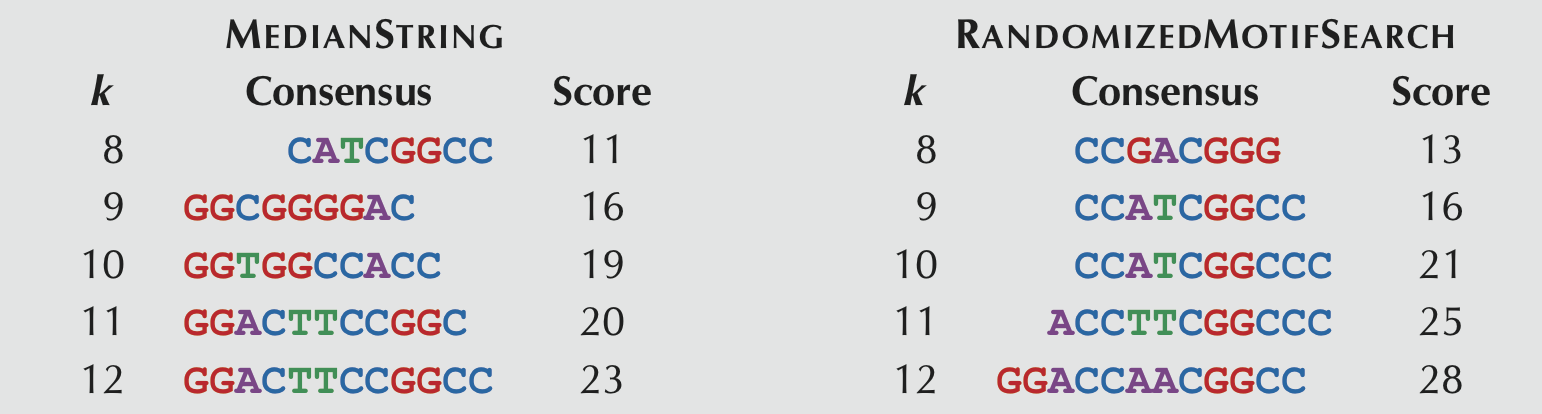
STOP and Think Can you infer the DosR binding site from these median strings? What do you think is the length of the binding site?
Note that although the consensus strings returned by RandomizedMotifSearch generally deviate from the median strings, the consensus string of length 12 (GGACCAACGGCC, with score 28) is very similar to the median string (GGACTTCCGGCC, with score 23).
While the motifs returned by RandomizedMotifSearch are slightly less conserved than the motifs returned by MedianString, the former algorithm has the advantage of being able to find longer motifs (since MedianString becomes too slow for longer motifs). The motif of length 20 returned by RandomizedMotifSearch is CGGGACCTACGTCCCTAGCC (with score 57). As shown below, the consensus strings of length 12 found by RandomizedMotifSearch and MedianString are “embedded” with small variations in the longer motif of length 20:
 GGACCAACGGCC

CGGGACCTACGTCCCTAGCC

 GGACTTCCGGCC
Finally, in 2,000 runs with N = 200, GibbsSampler returned the same consensus string of length 20 for the DosR dataset as RandomizedMotifSearch but generated a different collection of motifs with a smaller score of 55.
As you have seen in this chapter, different motif finding algorithms generate somewhat different results, and and it remains unclear how to find all DosR bonding sites in MTB. Try to answer this question and find all putative DosR motifs in MTB as well as all genes that they regulate. We will provide you with the upstream regions of ten of the 25 genes identified in the DosR study by Park et al., 2003 to help you address the following problem.
Final Challenge Use the DosR Dataset to infer the profile of the DosR motif and find all its putative occurrences in Mycobacterium tuberculosis.Solve it with the autograderFree to start in the interactive text
Bibliography Notes
Konopka and Benzer, 1971 bred flies with abnormally short (19 hours) and long (28 hours) circadian rhythms and then traced these abnormalities to a single gene. Harmer et al., 2000 discovered the evening transcription factor binding site that orchestrates the circadian clock in plants. Excellent coverage of this discovery is given by Cristianini and Hahn, 2006. Park et al., 2003 found a transcription factor that mediates the hypoxic response of Mycobacterium tuberculosis.
Hertz and Stormo, 1999 described the first greedy algorithm for motif finding. The general framework for Gibbs sampling was described by Geman and Geman, 1984 and was named Gibbs sampling in reference to its similarities with some approaches in statistical mechanics (Josiah Willard Gibbs was one of the founders of statistical mechanics). Lawrence et al., 1993 adapted Gibbs sampling for motif finding.