Lesson 1.6
Asymmetry of Replication
Watch the lectureFrom a Biological Insight Toward an Algorithm for Finding the Replication Origin (Part 1)
While biologists will feel at home with the following description of DNA replication, computer scientists may find it overloaded with new terms. If it seems too biologically complex, then feel free to skim this lesson, as long as you believe us that the replication process is asymmetric, i.e., that forward and reverse half-strands have very different fates with respect to replication. Alternatively, you may watch an excellent video describing strand asymmetry at Education Portal.
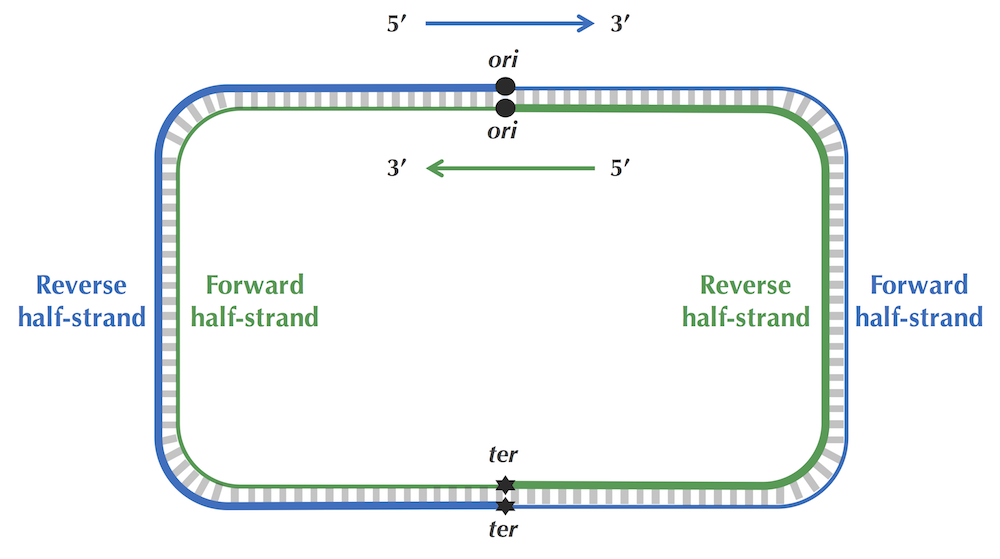
Since a DNA polymerase can only move in the reverse (3′ → 5′) direction, it can copy nucleotides non-stop from ori to ter along reverse half-strands, as shown in the figure below. However, replication on forward half-strands is very different because a DNA polymerase cannot move in the forward (5' → 3') direction; on these half-strands, a DNA polymerase must replicate backwards toward ori. Take a look at the figure below to see why this must be the case.

Figure: Replication begins at ori (primers shown in red) with the synthesis of fragments on the reverse half-strands (shown by thick lines). A DNA polymerase must wait until the replication fork has opened some (small) distance before it starts copying the forward half-strands (shown by thin lines) back toward ori.
On a forward half-strand, in order to replicate DNA, a DNA polymerase must wait for the replication fork to open a little (approximately 2,000 nucleotides) until a new primer is formed at the end of the replication fork; afterwards, the DNA polymerase starts replicating a small chunk of DNA starting from this primer and moving backward in the direction of ori. When the two DNA polymerases on forward half-strands reach ori, we have the situation shown below.
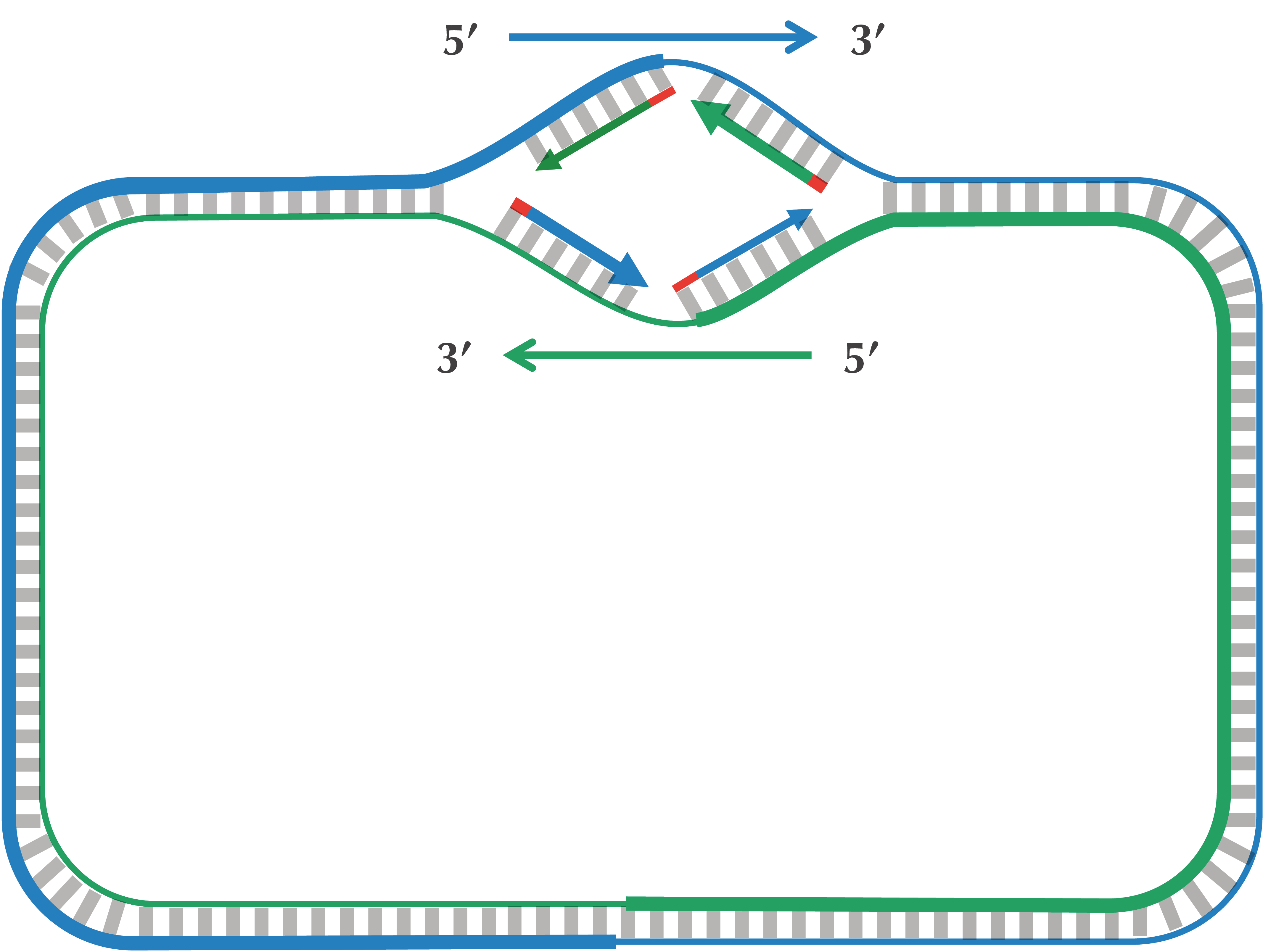
Figure: The daughter fragments are now synthesized (with some delay) on the forward half-strands (shown by thin lines).
After this point, replication on each reverse half-strand progresses continuously; however, a DNA polymerase on a forward half-strand has no choice but to wait again until the replication fork has opened another 2,000 nucleotides or so. It then requires a new primer to begin synthesizing another fragment back toward ori. On the whole, replication on a forward half-strand requires occasional stopping and restarting, which results in the synthesis of short Okazaki fragments from multiple primers that are complementary to intervals on the forward half-strands. You can see these fragments forming in the figure below.
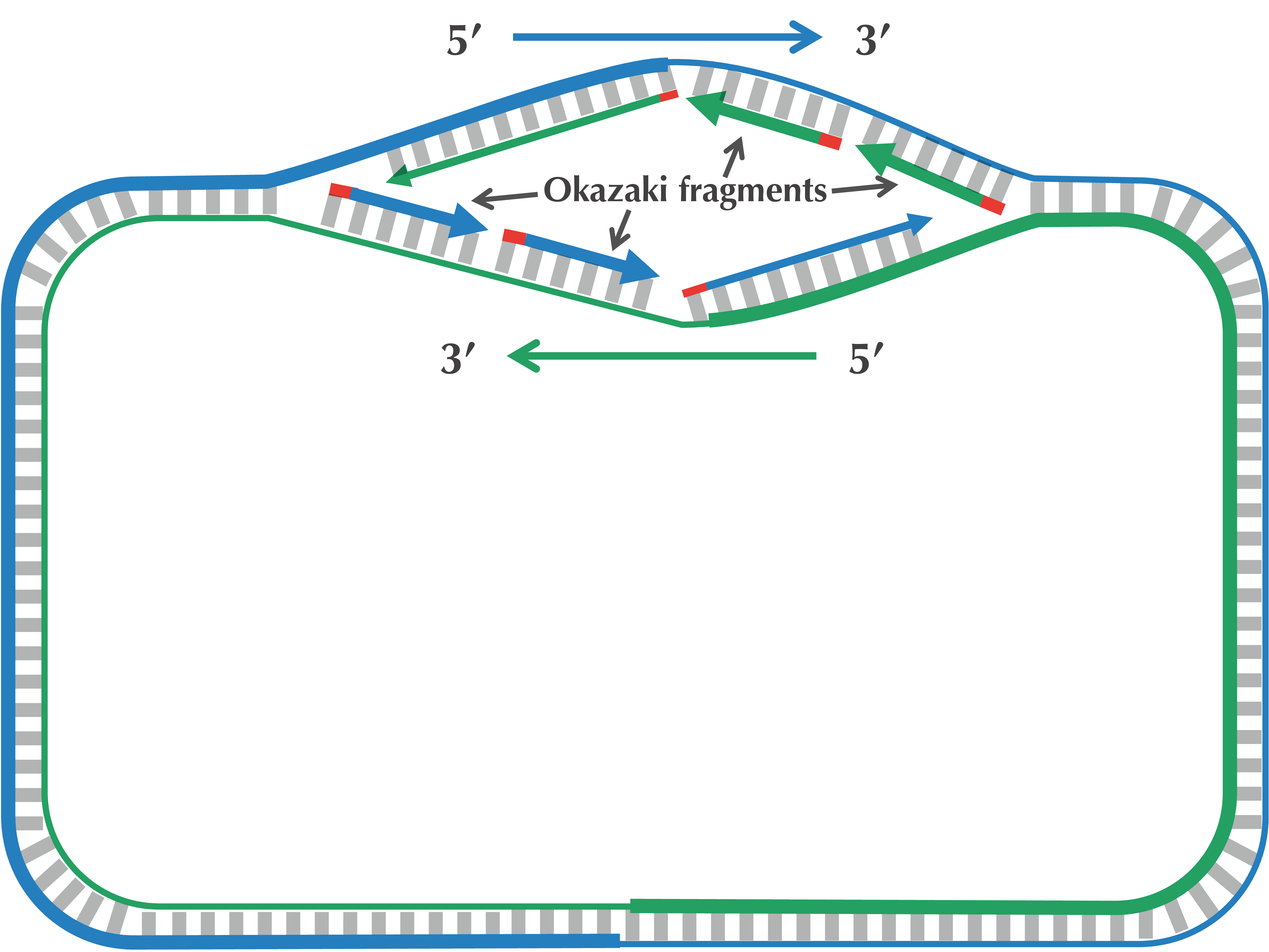
Figure: The replication fork continues growing. Only one primer is needed for each of the reverse half-strands (shown by thick lines), while the forward half-strands (shown by thin lines) require multiple primers in order to synthesize Okazaki fragments. Two of these primers are shown in red on each forward half-strand.
When the replication fork reaches ter, the replication process is almost complete, as all DNA has been synthesized. However, gaps still remain between the disconnected Okazaki fragments, as shown below.
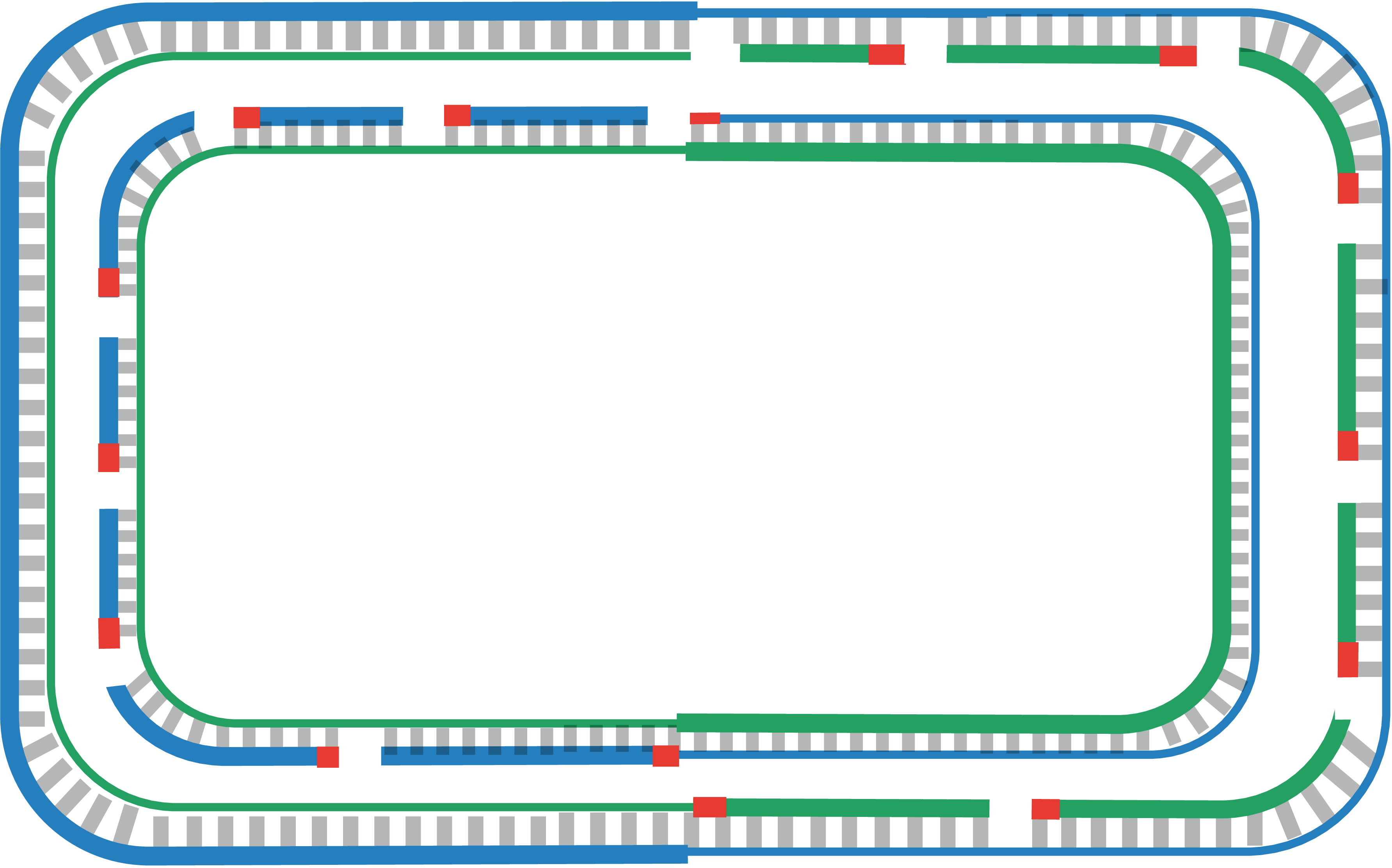
Finally, consecutive Okazaki fragments are sewn together by an enzyme called DNA ligase, resulting in two intact daughter chromosomes, each consisting of one parent strand and one newly synthesized daughter strand. In reality, DNA ligase does not wait until after all the Okazaki fragments have been replicated to start sewing them together.
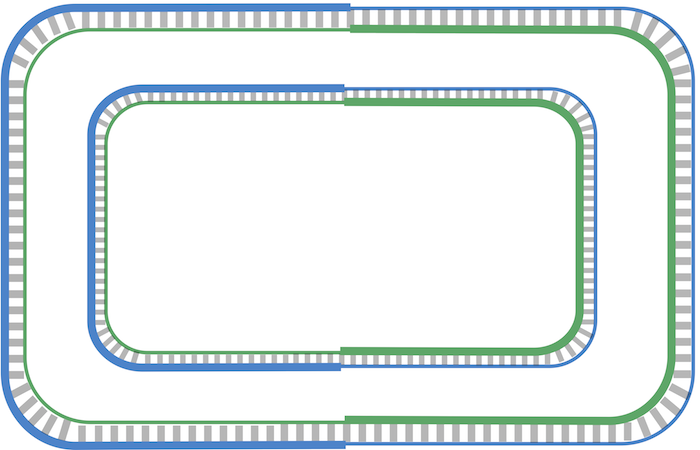
Biologists call a reverse half-strand (thick lines) a leading half-strand since a single DNA polymerase traverses this half-strand non-stop, and they call a forward half-strand (thin lines) a lagging half-strand since it is used as a template by many DNA polymerases stopping and starting replication.
If you are confused about the differences between the leading and lagging half-strands, you are not alone — we and legions of biology students are also confused. The confusion is exacerbated by the fact that different textbooks use different terminology depending on whether the authors intend to refer to a leading template half-strand or a leading half-strand that is being synthesized from a (lagging) template half-strand. You hopefully see why we have chosen the terms "reverse" and "forward" half-strands in an attempt to mitigate some of this confusion.