Lesson 1.5
The Simplest Way to Replicate DNA
Watch the lectureFrom a Biological Insight Toward an Algorithm for Finding the Replication Origin (Part 1)
We are now ready to discuss the replication process in more detail. As illustrated in the figure below, the two complementary DNA strands running in opposite directions around a circular chromosome unravel, starting at ori. As the strands unwind, they create two replication forks, which expand in both directions around the chromosome until the strands completely separate at the replication terminus (denoted ter). The replication terminus is located roughly opposite to ori in the chromosome.
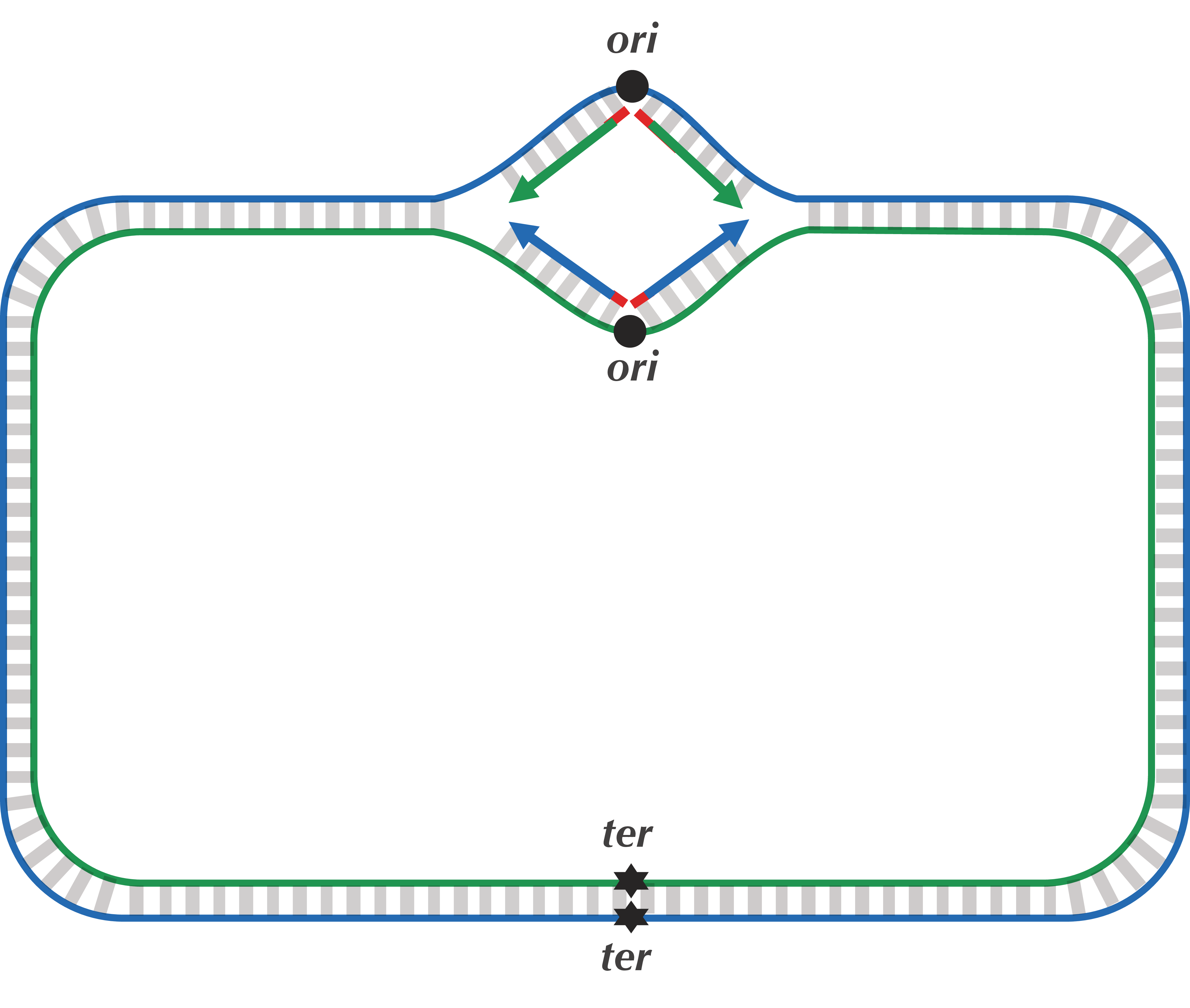
Figure: Four imaginary DNA polymerases at work replicating a chromosome as the replication forks extend from ori to ter. The blue strand is directed clockwise; the green strand is directed counterclockwise.
An important thing to know about replication is that a DNA polymerase does not wait for the two parent strands to completely separate before initiating replication; instead, it starts copying while the strands are unraveling, as shown in the figure above. Thus, just four DNA polymerases, each responsible for one half-strand, can all start at ori and replicate the entire chromosome. To start replication, a DNA polymerase needs a primer, a short complementary segment (shown in red above) that binds to the parent strand and jump starts the DNA polymerase. After the strands start separating, each of the four DNA polymerases starts replication by adding nucleotides, beginning with the primer and proceeding around the chromosome from ori to ter in either the clockwise or counterclockwise direction.
When all four DNA polymerases have reached ter, the chromosome's DNA will have been completely replicated, resulting in two pairs of complementary strands shown in the lower figure, and the cell is ready to divide.

Yet while you were reading this description, biology professors were writing a petition to have us fired and sent back to Biology 101. And they would be right, because our exposition suffers from a major flaw; we only described the replication process in this way so that you can better appreciate what we are about to reveal.
The problem with our current description is that it assumes that DNA polymerases can copy DNA in either direction along a strand of DNA (i.e., both 5’ → 3’ and 3’ → 5’). However, nature has not yet equipped DNA polymerases with this ability, as they are unidirectional, meaning that they can only traverse a template strand of DNA in the 3' → 5' direction, which is opposite from the 5’ → 3’ direction of DNA.
STOP and Think: If you were a unidirectional DNA polymerase, how would you replicate DNA? How many DNA polymerases would be needed to complete this task? Why?

Figure: DNA polymerase copies the template strand in the 3’ → 5’ direction. Note that it creates the daughter strand in the 5’ → 3’ direction. Courtesy Madeleine Price Ball.
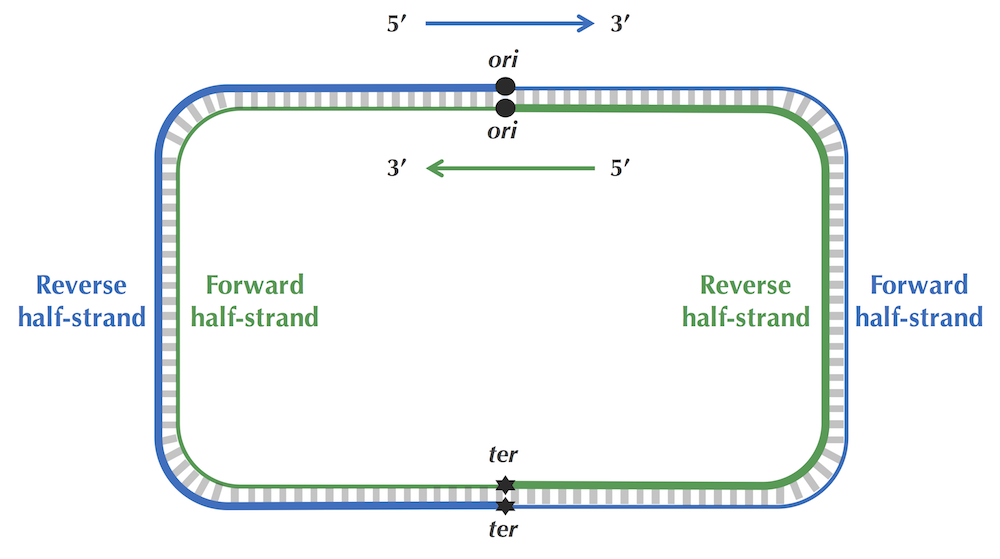
The unidirectionality of DNA polymerase requires a major revision to our naive model of replication. Imagine that you decided to walk along DNA from ori to ter. There are four different half-strands of parent DNA connecting ori to ter, as highlighted in the figure below. Two of these half-strands are traversed from ori to ter in the 5’ → 3’ direction and are thus called forward half-strands (represented by thin blue and green lines in the figure below). The other two half-strands are traversed from ori to ter in the 3’ → 5’ direction and are thus called reverse half-strands (represented by thick blue and green lines in the figure below).