
Chapter 4 Epilogue
From Simulated to Real Spectra
Watch the lectureThe Truth about Spectra
In this chapter, we have sheltered you from the gruesome realities of mass spectrometry by providing simulated spectra that are relatively easy to sequence (even those with false and missing masses). We committed a sin of omission by loosely describing the mass spectrometer as a “scale” and assuming that this complex machine simply weighs tiny peptide fragments one at a time. In truth, the mass spectrometer first converts subpeptides into ions (i.e., charged particles). Ionization of particles helps the mass spectrometer sort the ions by using an electromagnetic field; ions are separated not by their mass, but rather according to their mass/charge ratio. If fragment ion NQY (integer mass: 114 + 128 + 163 = 405) has charge +1, then it contains one additional proton, resulting in a total integer mass of 406 and a mass/charge ratio of 406/1 = 406. To be more precise, the monoisotopic mass of NQY is approximately 114.043 + 128.058 + 163.063 = 405.164, and the mass of a proton is 1.007 Da, which makes the mass charge/ratio more closely equal to (405.164 + 1.007)/1 = 406.171.
The mass spectrometer outputs a collection of peaks, which are shown below for a real Tyrocidine B1 spectrum. Each peak’s x-coordinate represents an ion's mass/charge ratio, and its height represents the intensity (i.e., relative abundance) of ions having that mass/charge ratio. For example, in the experimental spectrum of Tyrocidine B1 shown below, you will find a small (almost invisible) peak with a mass/charge ratio of 406.30,which corresponds to the fragment ion NQY having mass/charge ratio 406.171, with an error of approximately 0.13 Da.
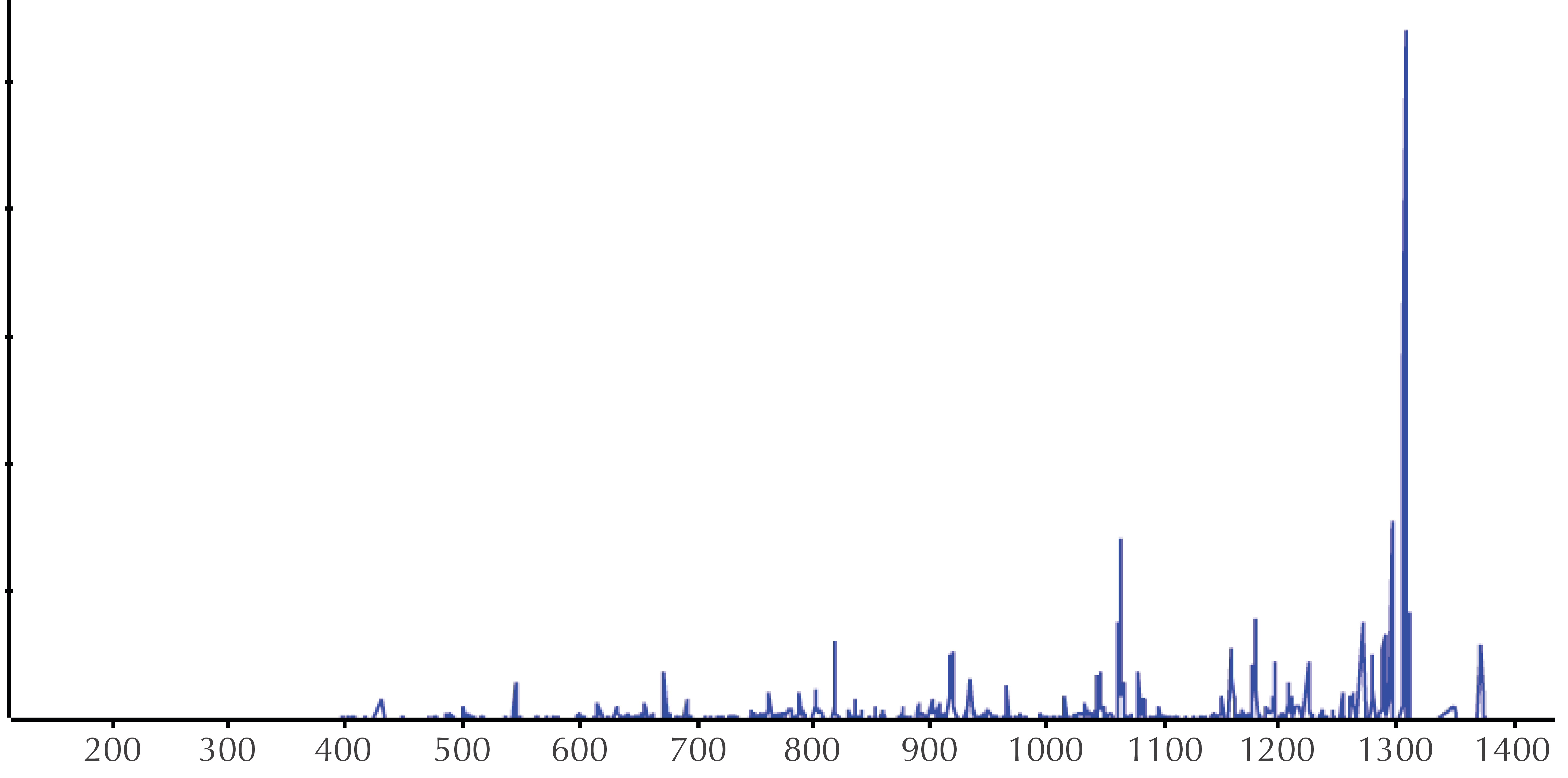
As you can imagine, we must navigate a few practical barriers in order to analyze real spectra. First, the charge of each peak is unknown, often forcing researchers to try all possible charges from 1 to some parameter maxCharge, where the particular choice of maxCharge depends on the fragmentation technology used. This procedure generates maxCharge masses for each peak, so that the larger the value of maxCharge, the more false masses in the spectrum.
Second, the real spectrum on the previous step has nearly 1000 peaks, most of which are false peaks, meaning that their mass/charge ratio does not correspond to any subpeptide’s mass/charge ratio (for any charge value). Fortunately, false peaks typically have low intensities, necessitating a pre-processing step that removes low-intensity peaks before applying an algorithm. Below is the list of the 95 mass/charge ratios for peaks that “survived” this preprocessing step for the Tyrocidine B1 spectrum. Their intensities may nevertheless vary by 2-3 orders of magnitude; for example, the intensity of the peak having mass/charge ratio 372.2 is 300 times smaller than the intensity of the peak with mass/charge ratio 1306.5.
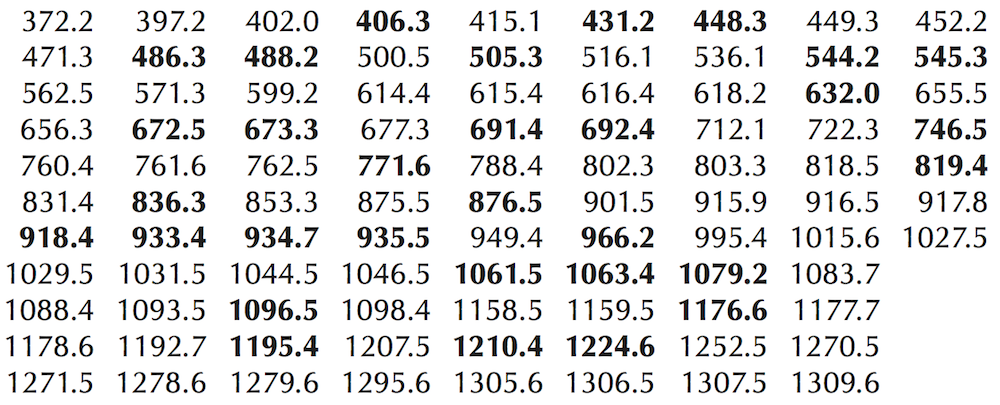
Figure: The 95 mass/charge ratios having the highest intensity in Figure 4.13. The values shown in bold correspond to masses of subpeptides of Tyrocidine B1, if we allow a mass discrepancy of up to 0.3 Da (see Figure 4.15).
Only 31 of these 95 mass/charge ratios (shown in bold in the figure on the previous step and reproduced below) can be matched to subpeptides of Tyrocidine B1 (with maxCharge = 1 and maximum allowable mass discrepancy of 0.3 Da):
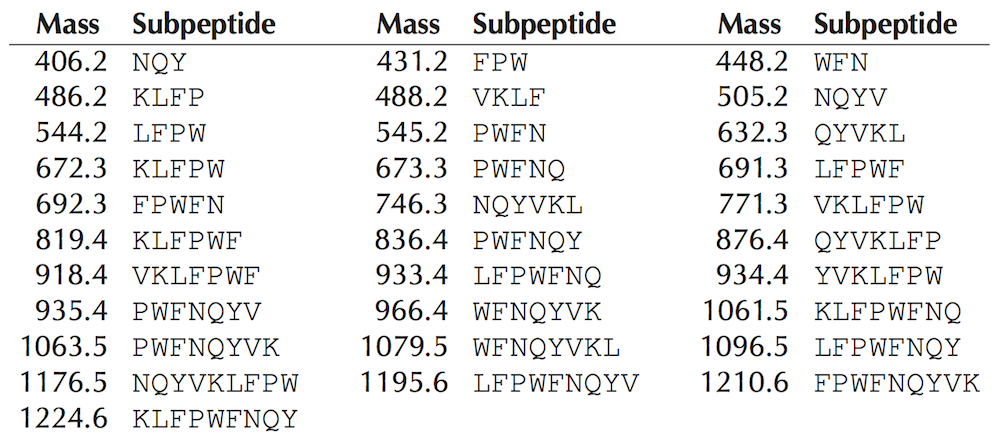
You can now see that sequencing Tyrocidine B1 from a real spectrum, for which two-thirds of all masses are false, presents a much more difficult problem than sequencing this peptide from the simulated Spectrum25. In the following challenge problem, you will need to further develop the methods we studied in this chapter to analyze a real spectrum.
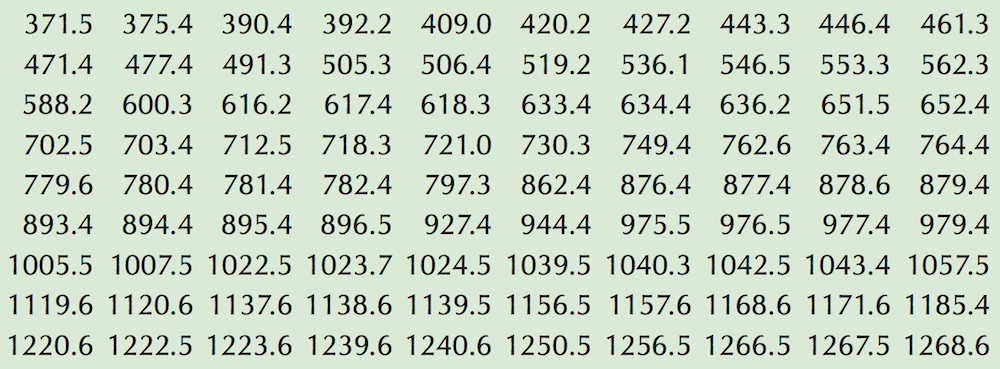
Final Challenge: (Solve this on Cogniterra.) Tyrocidine B1 is just one of many known NRPs produced by Bacillus brevis. A single bacterial species may produce dozens of different antibiotics, and even after 70 years of research, there are likely undiscovered antibiotics produced by Bacillus brevis. Try to sequence the tyrocidine corresponding to the real experimental spectrum below. Since the fragmentation technology used for generating the spectrum tends to produce ions with charge +1, you can safely assume that all charges are +1. Return the peptide as a collection of space-separated integer masses.Solve it with the autograderFree to start in the interactive text
Bibliography Notes
The pseudo-polynomial algorithm for the Turnpike Problem was proposed by Rosenblatt and Seymour, 1982. The first cyclopeptide sequencing algorithm was proposed by Ng et al., 2009. Tang et al., 1999 discovered theta-defensin. Venkataraman et al., 2009 showed that humans cells can be tricked into producing theta-defensin.