
Lesson 4.2
How Do Bacteria Make Antibiotics?
Watch the lectureHow Do Bacteria Make Antibiotics?
How peptides are encoded by the genome
Let’s begin by considering Tyrocidine B1, one of many antibiotics produced by Bacillus brevis. Tyrocidine B1 is defined by the 10 amino acid-long sequence shown below (using both the one-letter and three-letter notations for amino acids). Our goal in this section is to figure out how Bacillus brevis could have made this antibiotic.
Val-Lys-Leu-Phe-Pro-Trp-Phe-Asn-Gln-Tyr
V K L F P W F N Q Y
The Central Dogma of Molecular Biology states that “DNA makes RNA makes protein.” According to the Central Dogma, a gene from a genome is first transcribed into a strand of RNA composed of four ribonucleotides: adenine, guanine, cytosine, and uracil. A strand of RNA can be represented as an RNA string, formed over the four-letter alphabet {A, C, G, U}. You can think of the genome as a large cookbook, in which case the gene and its RNA transcript form a recipe in this cookbook. Then, the RNA transcript is translated into an amino acid sequence of a protein.
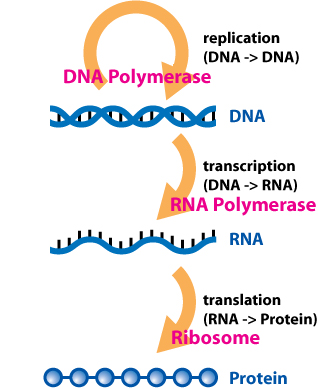
Much like replication, the chemical machinery underlying transcription and translation is fascinating, but from a computational perspective, both processes are straightforward. Transcription simply transforms a DNA string into an RNA string by replacing all occurrences of T with U. The resulting strand of RNA is translated into an amino acid sequence as follows. During translation, the RNA strand is partitioned into non-overlapping 3-mers called codons. Then, each codon is converted into one of 20 amino acids via the genetic code; the resulting sequence can be represented as an amino acid string formed over a 20-letter alphabet. As illustrated in the figure below, each of the 64 RNA codons encodes its own amino acid (some codons encode the same amino acid), with the exception of three stop codons that do not translate into amino acids and serve to halt translation. (For more details, see "DETOUR: Discovery of Codons" and "DETOUR: Split Genes" at Cogniterra or in the print companion.) For example, the DNA string TATACGAAA transcribes into the RNA string UAUACGAAA, which in turn translates into the amino acid string Y-T-K.
Figure: The genetic code describes the translation of an RNA 3-mer (codon) into one of 20 different amino acids. The first three circles, moving from the inside out, represent the 1st, 2nd, and 3rd nucleotides of a codon. The 4th, 5th, and 6th circles define the translated amino acid in three ways: the amino acid’s full name, its 3-letter abbreviation, and its single-letter abbreviation. Three of the 64 total RNA codons are stop codons, which halt translation. Reproduced from Open Clip Art.
We will represent the genetic code as an array GeneticCode containing 64 elements, as shown below.
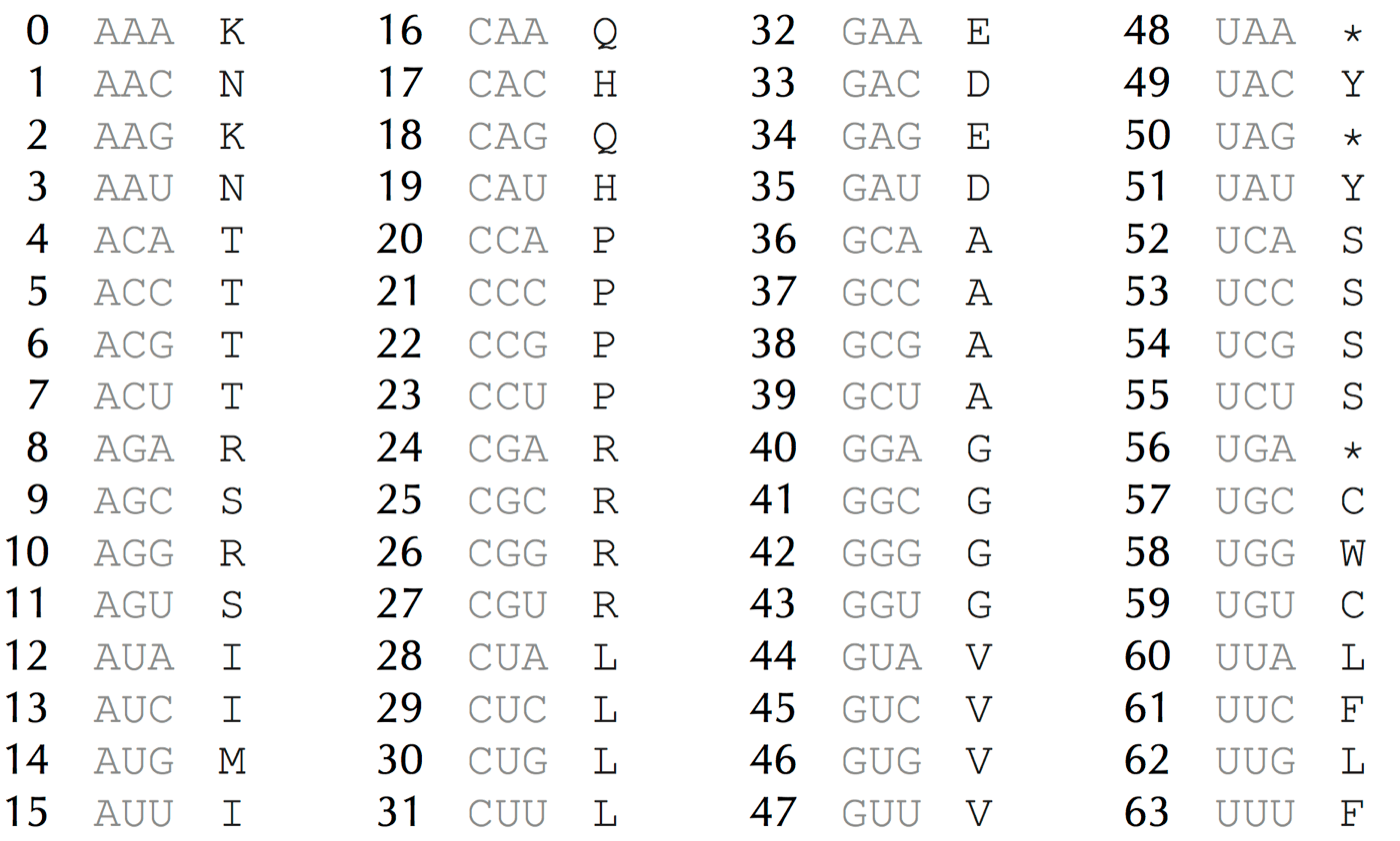
Figure: The array GeneticCode contains 64 elements, each of which is an amino acid or a stop codon (represented by *).
The following problem asks you to find the translation of an RNA string into an amino acid string.
Protein Translation Problem: Translate an RNA string into an amino acid string.
- Input: An RNA string Pattern and the array GeneticCode.
- Output: The translation of Pattern into an amino acid string Peptide.
Code Challenge Solve the Protein Translation Problem. (Solve at Cogniterra or Rosalind.)Solve it with the autograderFree to start in the interactive text
Exercise Break How many DNA strings of length 30 transcribe and translate into Tyrocidine B1? (Don't include the stop codon.) Test your solution at Cogniterra.
Recall that the amino acid sequence of Tyrocidine B1 is Val-Lys-Leu-Phe-Pro-Trp-Phe-Asn-Gln-Tyr. We also reproduce the genetic code figure below.
Where is Tyrocidine encoded in the Bacillus brevis genome?
Thousands of different DNA 30-mers could code for Tyrocidine B1, and we would like to know which one appears in the Bacillus brevis genome. There are three different ways to divide a DNA string into codons for translation, one starting at each of the first three starting positions of the string. These different ways of dividing a DNA string into codons are called reading frames. Since DNA is double-stranded, a genome has six reading frames (three on each strand), as shown in the figure below.

Figure: Six reading frames give six different ways for the same fragment of DNA to be transcribed and translated (three from each strand). The top three amino acid strings are read from left to right, whereas the bottom three strings are read from right to left. The highlighted amino acid string spells out the sequence of Tyrocidine B1. Stop codons are represented by STP.
We say that a DNA string Pattern encodes an amino acid string Peptide if the RNA string transcribed from either Pattern or its reverse complement Pattern translates into Peptide. For example, the DNA string GAAACT is transcribed into GAAACU and translated into ET. The reverse complement of this DNA string, AGTTTC, is transcribed into AGUUUC and translated into SF. Thus, GAAACT encodes both ET and SF.
Peptide Encoding Problem: Find substrings of a genome encoding a given amino acid sequence.
- Input: A DNA string Text, an amino acid string Peptide, and the array GeneticCode.
- Output: All substrings of Text encoding Peptide (if any such substrings exist).
Code Challenge Solve the Peptide Encoding Problem. (Solve at Cogniterra or Rosalind.)Solve it with the autograderFree to start in the interactive text
Exercise Break Solve the Peptide Encoding Problem for Bacillus brevis and Tyrocidine B1 (Val-Lys-Leu-Phe-Pro-Trp-Phe-Asn-Gln-Tyr). How many starting positions in Bacillus brevis encode this peptide? (Genetic code figure reproduced below.) Test your solution at Cogniterra.
After solving the Peptide Encoding Problem for Tyrocidine B1, we should be able to find a 30-mer in the Bacillus brevis genome encoding Tyrocidine B1, and yet no such 30-mer exists!
STOP and ThinkHow could a bacterium produce a peptide that is not encoded by the bacterium’s genome?
From linear to cyclic peptides
Neither Gause nor Synge was aware of it, but tyrocidines and gramicidins are actually cyclic peptides; the cyclic representation for Tyrocidine B1 is shown on the left in the figure below. Thus, Tyrocidine B1 has ten different linear representations, and we should run the Peptide Encoding Problem on every one of these sequences to find potential 30-mers coding for Tyrocidine B1. Yet when we solve the Peptide Encoding Problem for each of the ten strings on the right in the figure below, we find no 30-mer in the Bacillus brevis genome encoding Tyrocidine B1!
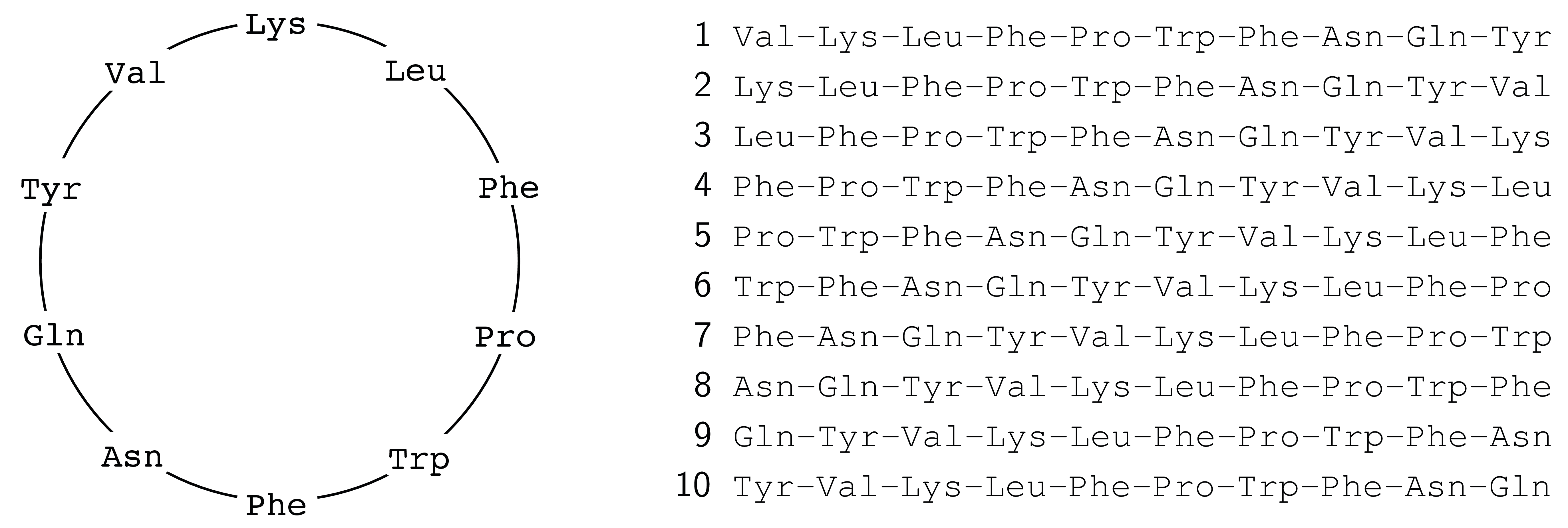
Figure: Tyrocidine B1 is a cyclic peptide (left), and so it has ten different linear representations (right).