
Lesson 4.4
Sequencing Antibiotics by Shattering Them into Pieces
Watch the lectureSequencing Antibiotics by Shattering them into Pieces
Introduction to mass spectrometry
Since NRPs do not adhere to the Central Dogma, we cannot infer them from the genome, which brings us back to where we started. What makes sequencing these peptides even more difficult is that many NRPs (including tyrocidines and gramicidins) are cyclic. Thus, the standard tools for sequencing linear peptides, which we will describe in a follow-up chapter, are not applicable to NRP analysis.
The workhorse of peptide sequencing is the mass spectrometer, an expensive molecular scale that shatters molecules into pieces and then weighs the resulting fragments. The mass spectrometer measures the mass of a molecule in daltons (Da); 1 Da is approximately equal to the mass of a single nuclear particle (i.e., a proton or neutron).
We will approximate the mass of a molecule by simply adding the number of protons and neutrons found in the molecule’s constituent atoms, which yields the molecule’s integer mass. For example, the amino acid glycine, which has chemical formula C2H3ON, has an integer mass of 57, since 2·12 + 3·1 + 1·16 + 1·14 = 57. Yet 1 Da is not exactly equal to the mass of a proton/neutron, and we may need to account for different naturally occurring isotopes of each atom when weighing a molecule (for more details, see "DETOUR: Molecular Mass" in the print companion or at Cogniterra). As a result, amino acids typically have non-integer masses (e.g., glycine has total integer mass equal to approximately 57.02 Da); for simplicity, however, we will work with the integer mass table given below.

Tyrocidine B1, which is represented by VKLFPWFNQY, has total mass 1322 Da (99 + 128 + 113 + 147 + 97 + 186 + 147 + 114 + 128 + 163 = 1322).
The mass spectrometer can break each molecule of Tyrocidine B1 into two linear fragments, and it analyzes samples that may contain billions of identical copies of the peptide, with each copy breaking in its own way. One copy may break into LFP and WFNQYVK (with respective masses 357 and 965), whereas another may break into PWFN and QYVKLF. Our goal is to use the masses of these and other fragments to sequence the peptide. The collection of all the fragment masses generated by the mass spectrometer is called an experimental spectrum.
STOP and Think How can we use the experimental spectrum to sequence a peptide?
The Cyclopeptide Sequencing Problem
For now, we will assume for simplicity that the mass spectrometer breaks the copies of a cyclic peptide at every possible two bonds, so that the resulting experimental spectrum contains the masses of all possible linear fragments of the peptide, which are called subpeptides. For example, the cyclic peptide NQEL has 12 subpeptides: N, Q, E, L, NQ, QE, EL, LN, NQE, QEL, ELN, and LNQ. We will also assume that subpeptides may occur more than once if an amino acid occurs multiple times in the peptide (e.g., ELEL also has 12 subpeptides: E, L, E, L, EL, LE, EL, LE, ELE, LEL, ELE, and LEL.
Exercise Break How many subpeptides does a cyclic peptide of length n have? Test your solution at Cogniterra.
The theoretical spectrum of a cyclic peptide Peptide, denoted Cyclospectrum(Peptide), is the collection of all of the masses of its subpeptides, in addition to the mass 0 and the mass of the entire peptide, with masses ordered from smallest to largest. We will assume that the theoretical spectrum can contain duplicate elements, as is the case for NQEL (shown below), where NQ and EL have the same mass.

Generating Theoretical Spectrum Problem: Generate the theoretical spectrum of a cyclic peptide.
- Input: An amino acid string Peptide.
- Output: Cyclospectrum(Peptide).
Code Challenge Solve the Generating Theoretical Spectrum Problem. (Solve at Cogniterra or Rosalind.) Solve it with the autograderFree to start in the interactive text
Note: An obvious approach for solving the Generating Theoretical Spectrum Problem would be to construct a list containing all subpeptides of Peptide, and then find the mass of each subpeptide by adding the integer masses of its constituent amino acids. This approach will work, but you may like to check out "Charging Station: Generating the Theoretical Spectrum of a Peptide" in the print companion or at Cogniterra to see a more elegant algorithm that applies to both linear and cyclic peptides.
Generating the theoretical spectrum of a known peptide is easy, but our aim is to solve the reverse problem of reconstructing an unknown peptide from its experimental spectrum. We will start by assuming that a biologist is lucky enough to generate an ideal spectrum, which is one coinciding with the peptide’s theoretical spectrum.
Cyclopeptide Sequencing Problem: Given an ideal spectrum, find a cyclic peptide whose theoretical spectrum matches the experimental spectrum.
- Input: A collection of (possibly repeated) integers Spectrum corresponding to an ideal spectrum.
- Output: An amino acid string Peptide such that Cyclospectrum(Peptide) = Spectrum (if such a string exists).
STOP and Think Consider the theoretical spectrum for Tyrocidine B1 shown below; if an experiment produced this spectrum, how would you reconstruct the amino acid sequence of Tyrocidine B1?
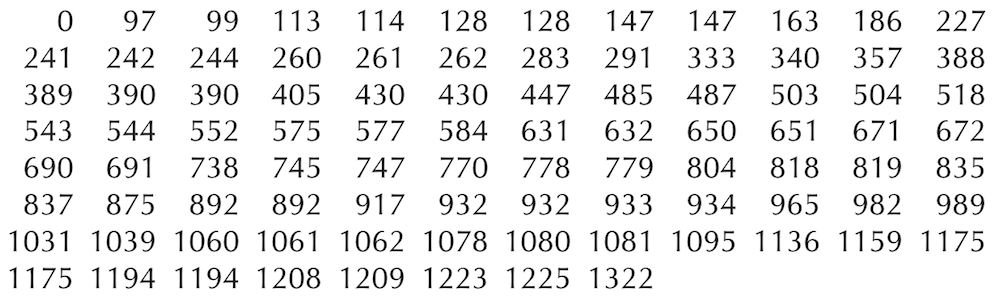
From now on, we will sometimes work directly with amino acid masses, taking the liberty to represent a peptide by a sequence of integers denoting the peptide’s constituent amino acid masses. For example, we represent NQEL as 114-128-129-113 and Tyrocidine B1 (VKLFPWFNQY) as 99-128-113-147-97-186-147-114-128-163. We have therefore replaced an alphabet of 20 amino acids with an alphabet of only 18 integers because two amino acid pairs have the same integer mass:
G   A   S   P   V    T    C   I/L   N    D   K/Q   E    M    H    F    R    Y    W
57  71  87  97  99  101  103  113  114  115  128  129  131  137  147  156  163  186
Note that in the general case (when we are not restricted to the amino acid alphabet), the Cyclopeptide Sequencing Problem could have multiple solutions. For example, “peptides” 1-1-3-3 and 1-2-1-4 have the same theoretical spectrum {1, 1, 2, 3, 3, 4, 4, 5, 5, 6, 7, 7}.
STOP and Think We don’t know whether there exist different peptides (in the alphabet of 18 amino acid masses) with identical theoretical spectra — can you find such peptides?
Note: This question may be difficult to answer.