
Lesson 3.3
String Reconstruction as a Walk in the Overlap Graph
Watch the lectureString Reconstruction as a Hamiltonian Path Problem
From a string to a graph
Repeats in a genome necessitate some way of looking ahead to see the correct assembly in advance. Returning to our above example, you may have already found that TAATGCCATGGGATGTT is a solution to the String Reconstruction Problem for the collection of fifteen 3-mers in the last section, as illustrated below. Note that we use a different color for each interval of the string between occurrences of ATG.
TAA
AAT
ATG
TGC
GCC
CCA
CAT
ATG
TGG
GGG
GGA
GAT
ATG
TGT
GTT
TAATGCCATGGGATGTT
STOP and Think Is this the only solution to the String Reconstruction Problem for this collection of 3-mers?
In the figure below, consecutive 3-mers in TAATGCCATGGGATGTT are linked together to form this string's genome path.

Figure: The fifteen color-coded 3-mers making up TAATGCCATGGGATGTT are joined into the genome path according to their order in the genome.
String Spelled by a Genome Path Problem. Reconstruct a string from its genome path.
- Input: A sequence path of k-mers Pattern1, … ,Patternn such that the last k - 1 symbols of Patterni are equal to the first k-1 symbols of Patterni+1 for 1 ≤ i ≤ n-1.
- Output: A string Text of length k+n-1 such that the i-th k-mer in Text is equal to Patterni (for 1 ≤ i ≤ n).
Reconstructing the genome from its genome path is easy: as we proceed from left to right, the 3-mers “spell’ out TAATGCCATGGGATGTT, adding one new symbol to the genome at each new 3-mer. This yields a function PathToGenome(path).
Unfortunately, constructing the genome path requires us to know the genome in advance.
Code Challenge Solve the String Spelled by a Genome Path Problem. (Solve on Cogniterra or Rosalind.)Solve it with the autograderFree to start in the interactive text
STOP and Think Could you construct the genome path if you knew only the genome’s 3-mer composition?
In this chapter, we will use the terms prefix and suffix to refer to the first k − 1 nucleotides and last k − 1 nucleotides of a k-mer, respectively. For example, Prefix(TAA) = TA and Suffix(TAA) = AA. We note that the suffix of a 3-mer in the genome path is equal to the prefix of the following 3-mer in the path. For example, Suffix(TAA) = Prefix(AAT) = AA in the genome path for TAATGCCATGGGATGTT, shown again below.
This observation suggests a method of constructing a string's genome path from its k-mer composition: we will use an arrow to connect any k-mer Pattern to a k-mer Pattern' if the suffix of Pattern is equal to the prefix of Pattern'.
STOP and Think Apply this rule to the 3-mer composition of TAATGCCATGGGATGTT. Are you able to reconstruct the genome path for TAATGCCATGGGATGTT?
If we strictly follow the rule of connecting two 3-mers with an arrow every time the suffix of one is equal to the prefix of the other, then we will connect all consecutive 3-mers in TAATGCCATGGGATGTT. However, because we don’t know this genome in advance, we wind up having to connect many other pairs of 3-mers as well. For example, each of the three occurrences of ATG should be connected to TGC, TGG, and TGT, as shown in the figure below.
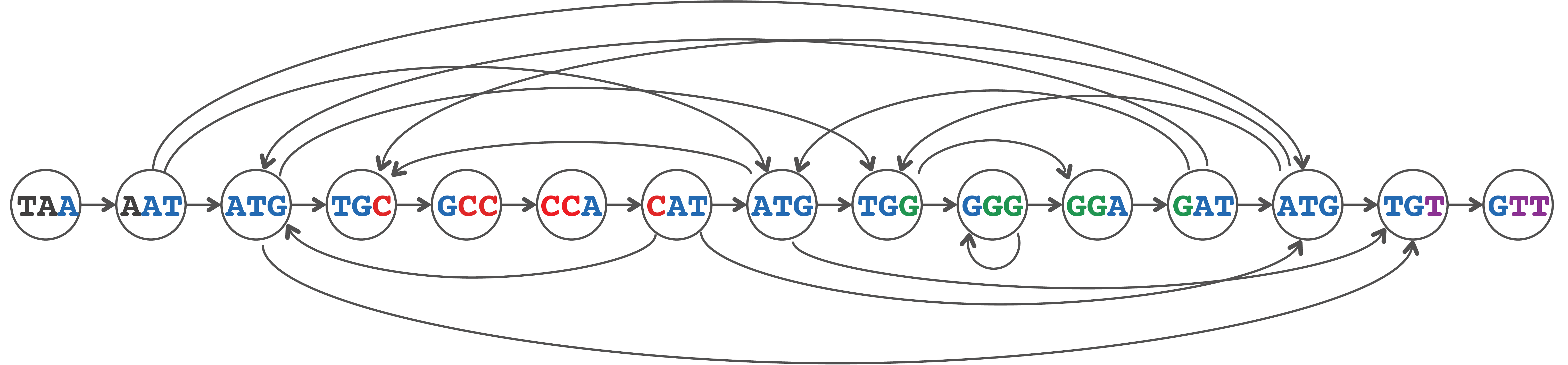
Figure: The graph showing all connections between nodes representing the 3-mer composition of TAATGCCATGGGATGTT. This graph has fifteen nodes and 28 edges. Note that the genome can still be spelled out by walking along the horizontal edges from TAA to GTT.
The figure above presents an example of a graph, or a network of nodes connected by edges. This particular graph is an example of a directed graph, whose edges have a direction and are represented by arrows (as opposed to undirected graphs whose edges do not have directions). If you are unfamiliar with graphs, see "DETOUR: An Introduction to Graphs" in the print companion or at Cogniterra.
The genome vanishes
The genome can still be traced out in the graph from the previous page (reproduced above) by following the horizontal path from TAA to GTT. But in genome sequencing, we do not know in advance how to correctly order reads. Therefore, we will arrange the 3-mers lexicographically, which produces the overlap graph shown in the figure below. The genome path has disappeared!
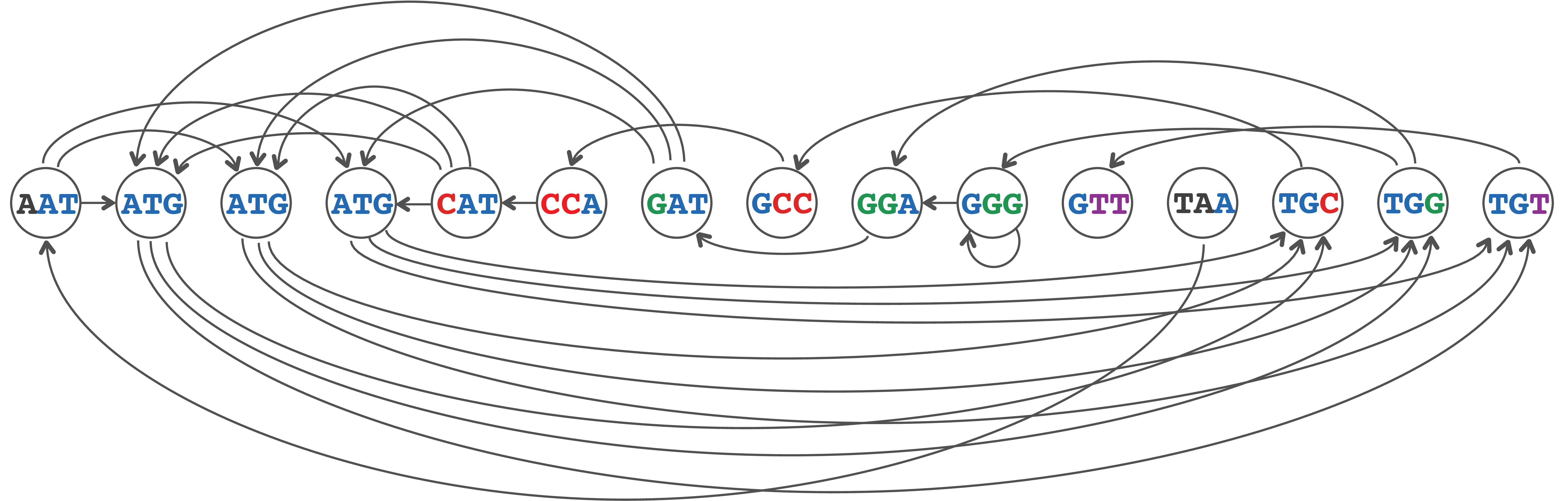
Figure: The same graph as the one in the figure at the top of the page, with 3-mers ordered lexicographically. The path through the graph representing the correct assembly is now harder to see.
The genome path may have disappeared to the naked eye, but it must still be there, since we have simply rearranged the nodes of the graph.
Indeed, the figure below highlights the genome path spelling out TAATGCCATGGGATGTT. However, if we had given you this graph to begin with, you would have needed to find a path through the graph visiting each node exactly once; such a path "explains" all the 3-mers in the 3-mer composition of the genome. Although finding such a path is currently just as difficult as trying to assemble the genome by hand, the graph nevertheless gives us a nice way of visualizing the overlap relationships between reads.
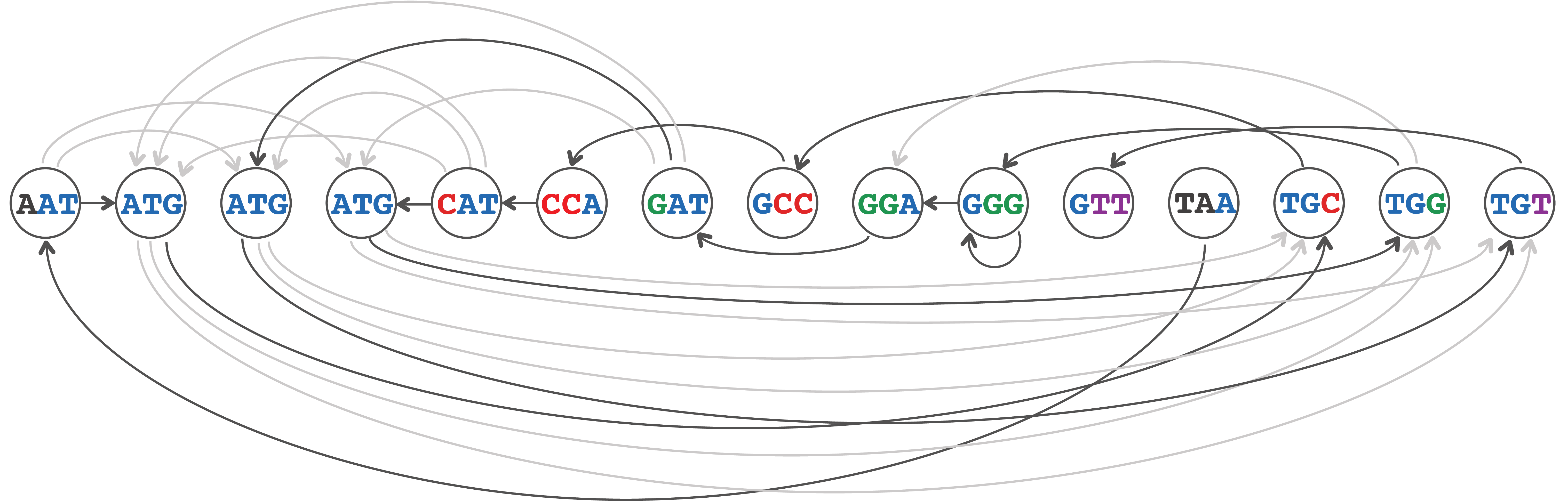
Figure: The genome path spelling out TAATGCCATGGGATGTT, highlighted in the overlap graph.
STOP and Think Can any other strings be reconstructed by following a path visiting all the nodes in the figure above?
To generalize the construction of the above graph to an arbitrary collection of k-mers Patterns, we form a node for each k-mer in Patterns and connect k-mers Pattern and Pattern' by a directed edge if Suffix(Pattern) is equal to Prefix(Pattern'). The resulting graph is called the overlap graph on these k-mers, denoted Overlap(Patterns).
Overlap Graph Problem: Construct the overlap graph of a collection of k-mers.
- Input: A collection Patterns of k-mers.
- Output: The overlap graph Overlap(Patterns).
Two graph representations
If you have never worked with graphs before, you may be wondering how to represent graphs in your programs. To make a brief digression from our discussion of genome assembly, consider the graph in the figure below. We can move around this graph’s nodes without changing the graph. As a result, when we are representing a graph computationally, the only information we need to store is the pair of nodes that each edge connects.
There are two standard ways of representing a graph. For a directed graph with n nodes, the n × n adjacency matrix (Ai,j) is defined by the following rule: Ai,j = 1 if a directed edge connects node i to node j, and Ai,j = 0 otherwise. Another (more memory-efficient) way of representing a graph is to use an adjacency list, for which we simply list all nodes connected to each node. See figure below.
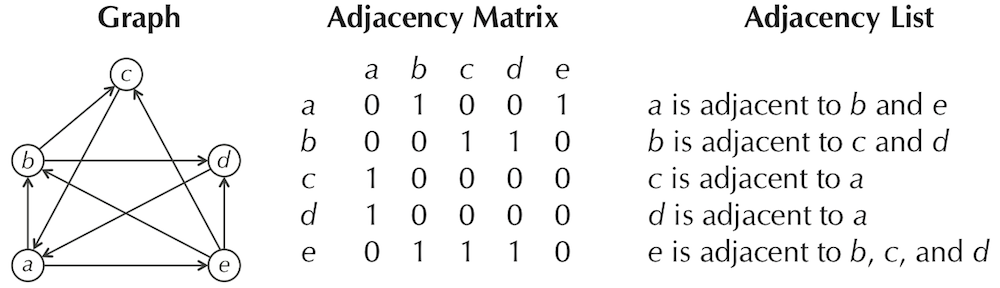
Figure: A graph with five nodes and nine edges, followed by its adjacency matrix and adjacency list.
You should now be ready to apply your knowledge to solve the Overlap Graph Problem.
Code Challenge Solve the Overlap Graph Problem, restated below. (Solve on Cogniterra or Rosalind.)Solve it with the autograderFree to start in the interactive text
- Input: A collection Patterns of k-mers.
- Output: The overlap graph Overlap(Patterns), in the form of an adjacency list. (You may return the nodes and their edges in any order.)
Hamiltonian paths and universal strings
We now know that to solve the String Reconstruction Problem, we are looking for a path in the overlap graph that visits every node exactly once. A path in a graph visiting every node once is called a Hamiltonian path, in honor of the Irish mathematician William Hamilton. For more details, see "DETOUR: The Icosian Game" in the print companion or at Cogniterra.
As the figure below illustrates, a graph may have more than one Hamiltonian path.
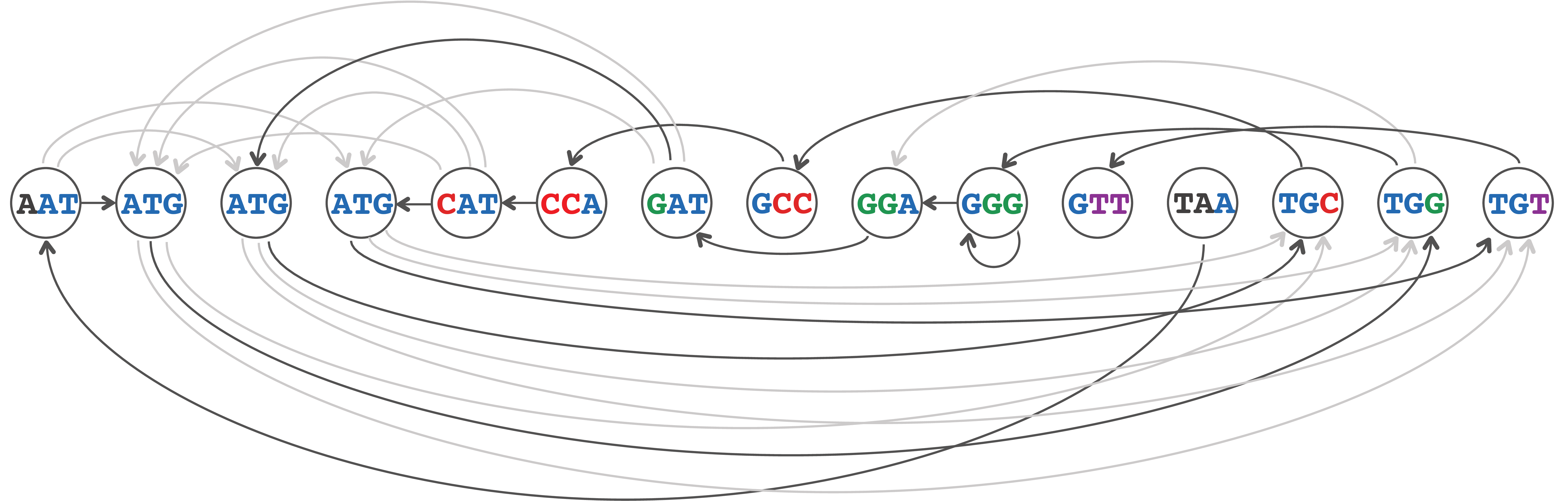
Figure: In addition to the Hamiltonian path that reconstructs TAATGCCATGGGATGTT, another Hamiltonian path in the overlap graph spells the genome TAATGGGATGCCATGTT. These two genomes differ by exchanging the positions of CC and GG but have the same 3-mer composition.
Hamiltonian Path Problem: Construct a Hamiltonian path in a graph.
- Input: A directed graph.
- Output: A path visiting every node in the graph exactly once (if such a path exists).
We do not ask you to solve the Hamiltonian Path Problem yet, since it is not clear how we could design an efficient algorithm for it. Instead, we want you to meet Nicolaas de Bruijn, a Dutch mathematician. In 1946, de Bruijn was interested in solving a purely theoretical problem, described as follows. A binary string is a string composed only of 0’s and 1’s; a binary string is k-universal if it contains every binary k-mer exactly once. For example, 0001110100 is a 3-universal string, as it contains each of the eight binary 3-mers (000, 001, 011, 111, 110, 101, 010, and 100) exactly once.
Finding a k-universal string is equivalent to solving the String Reconstruction Problem when the k-mer composition is the collection of all binary k-mers. Thus, finding a k-universal string can be reduced to finding a Hamiltonian path in the overlap graph formed on all binary k-mers (see the figure below). Although the Hamiltonian path below can easily be found by hand, de Bruijn was interested in constructing k-universal strings for arbitrary values of k. For example, to find a 20-universal string, you would have to consider a graph with over a million nodes. It is absolutely unclear how to find a Hamiltonian path in such a huge graph, or even whether such a path exists!
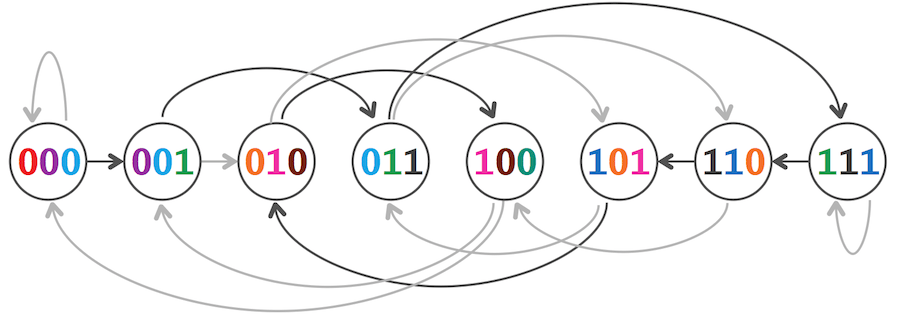
Figure: A Hamiltonian path (connecting node 000 to 100) in the overlap graph of all binary 3-mers.
Instead of searching for Hamiltonian paths in huge graphs, de Bruijn developed a completely different (and somewhat non-intuitive) way of representing a k-mer composition using a graph. Later in this chapter, we will learn how he used this method to construct universal strings.
Exercise Break: Construct a 4-universal string.