
Lesson 3.6
The Seven Bridges of Königsberg
Watch the lectureThe Bridges of Konigsberg and Genome Assembly
Our destination is 1735 and the Prussian city of Königsberg. This city, which today is Kaliningrad, Russia, comprised both banks of the Pregel River as well as two river islands; seven bridges connected these four different parts of the city, as illustrated below. Königsberg’s residents enjoyed taking walks, and they asked a natural question: Is it possible to set out from my house, cross each bridge exactly once, and return home? Their question became known as the Bridges of Königsberg Problem.
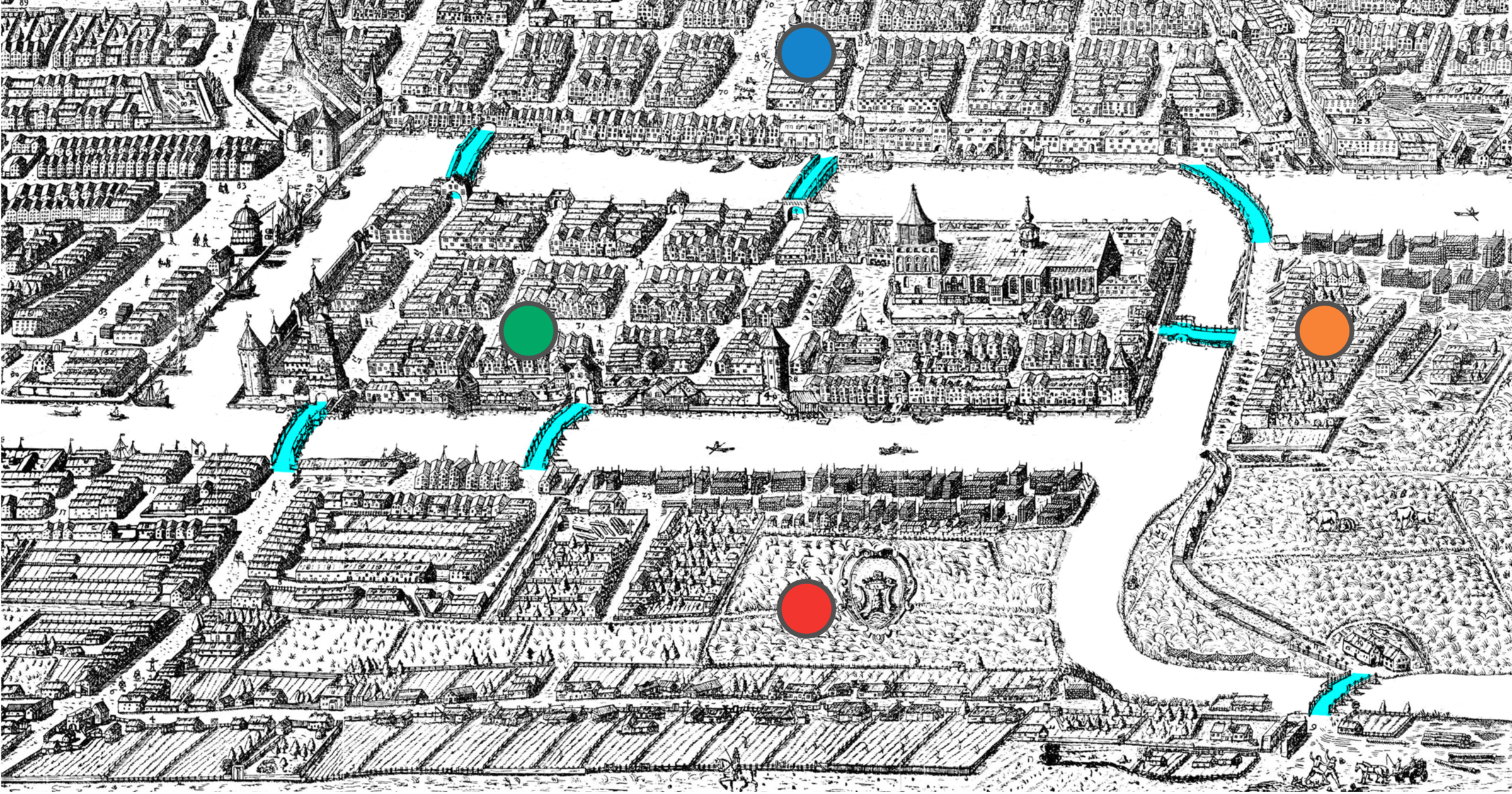
Figure: A map of Königsberg, adapted from Joachim Bering’s 1613 illustration. The city was made up of four sectors represented by the blue, red, yellow, and green dots. The seven bridges connecting the different parts of the city have been highlighted to make them easier to see.
Exercise Break Does the Bridges of Königsberg Problem have a solution?
In 1735, Leonhard Euler drew the graph shown below, which we call Königsberg; this graph’s nodes represent the four sectors of the city, and its edges represent the seven bridges connecting different sectors. Note that the edges of Königsberg are undirected, meaning that they can be traversed in either direction.
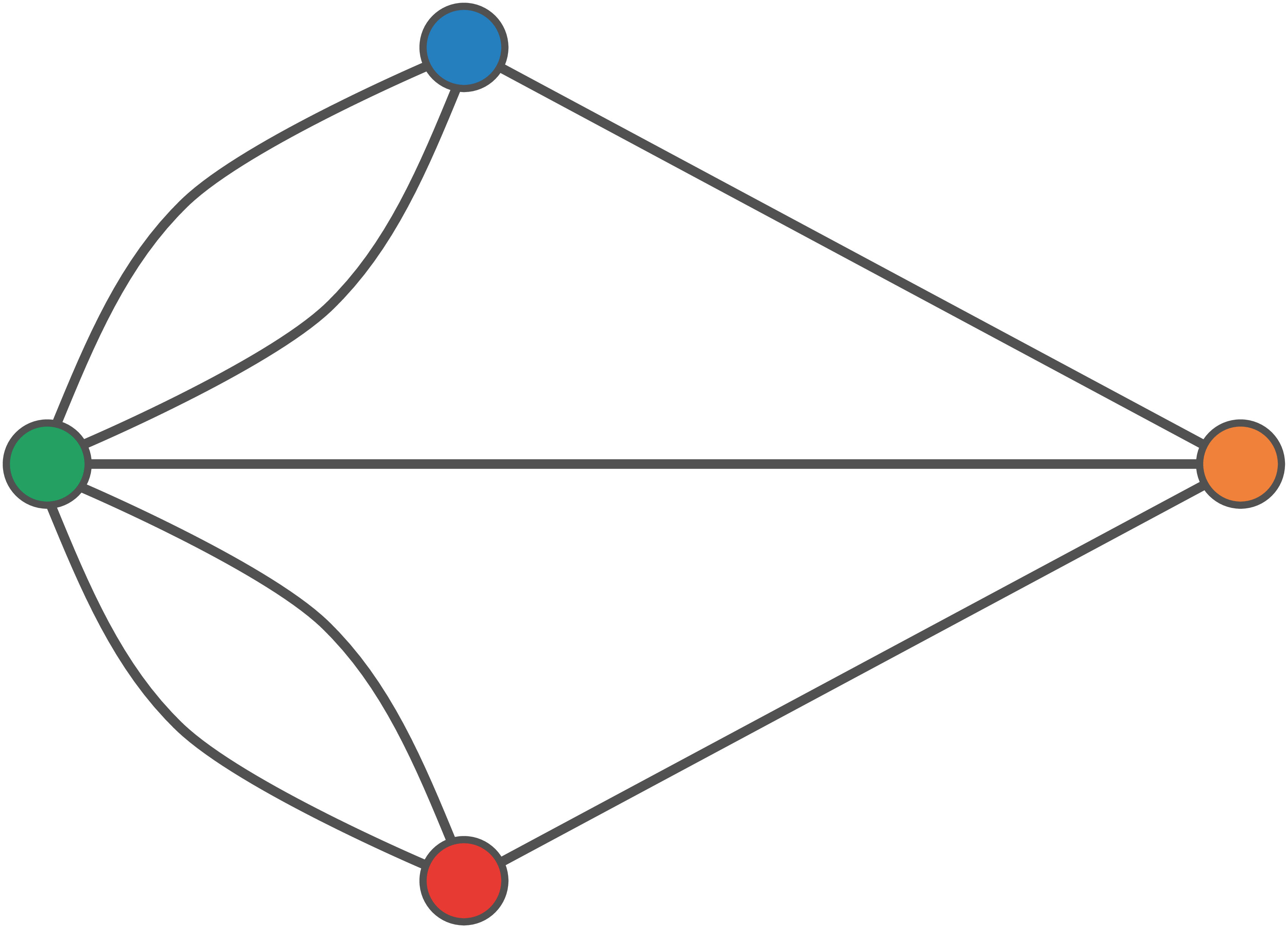
Figure: The graph Königsberg.
STOP and Think Redefine the Bridges of Königsberg Problem as a question about the graph Königsberg.
We have already defined an Eulerian path as a path in a graph traversing each edge of a graph exactly once. A cycle that traverses each edge of a graph exactly once is called an Eulerian cycle, and we say that a graph containing such a cycle is Eulerian. Note that an Eulerian cycle in Königsberg would immediately provide the residents of the city with the walk they had wanted. We now can redefine the Bridges of Königsberg Problem as an instance of the following more general problem.
Eulerian Cycle Problem: Find an Eulerian cycle in a graph.
- Input: A graph.
- Output: An Eulerian cycle in this graph, if one exists.
Euler solved the Bridges of Königsberg Problem, showing that no walk can cross each bridge exactly once (i.e., the graph Königsberg is not Eulerian), which you may have already figured out for yourself. Yet his real contribution, and the reason why he is viewed as the founder of the mathematical field of graph theory, a field of study that still flourishes today, is that he proved a theorem dictating precisely when a graph will have an Eulerian cycle. His theorem immediately implies an efficient algorithm for constructing an Eulerian cycle in any Eulerian graph, even one having millions of edges. Furthermore, this algorithm can easily be extended into an algorithm constructing an Eulerian path (in a graph having such a path), which will allow us to solve the String Reconstruction Problem by using the de Bruijn graph.
On the other hand, it turns out that no one has ever been able to find an efficient algorithm solving the Hamiltonian Path Problem. The search for such an algorithm, or for a proof that an efficient algorithm does not exist for this problem, is at the heart of one of the most fundamental unanswered questions in computer science. Computer scientists classify an algorithm as polynomial if its running time can be bounded by a polynomial in the length of the input data. On the other hand, an algorithm is exponential if its runtime on some datasets is exponential in the length of the input data. Although Euler's algorithm is polynomial, the Hamiltonian Path Problem belongs to a special class of problems for which all attempts to develop a polynomial algorithm have failed (see "DETOUR: Tractable and Intractable Problems" in the print companion or at Cogniterra). Yet instead of trying to solve a problem that has stumped computer scientists for four decades, we will set aside the overlap graph and instead focus on the de Bruijn graph approach to genome assembly.
For the first two decades following the invention of DNA sequencing methods, biologists assembled genomes using overlap graphs, since they failed to recognize that the Bridges of Königsberg held the key to DNA assembly. (For more details, see "DETOUR: From Euler to Hamilton to de Bruijn" in the print companion or at Cogniterra.) Indeed, overlap graphs were used to assemble the human genome. It took bioinformaticians some time to figure out that the de Bruijn graph, first constructed to solve a completely theoretical problem, was relevant to genome assembly. Moreover, when the de Bruijn graph was brought to bioinformatics, it was considered an exotic mathematical concept with limited practical applications. Today, the de Bruijn graph has become the dominant approach for genome assembly.